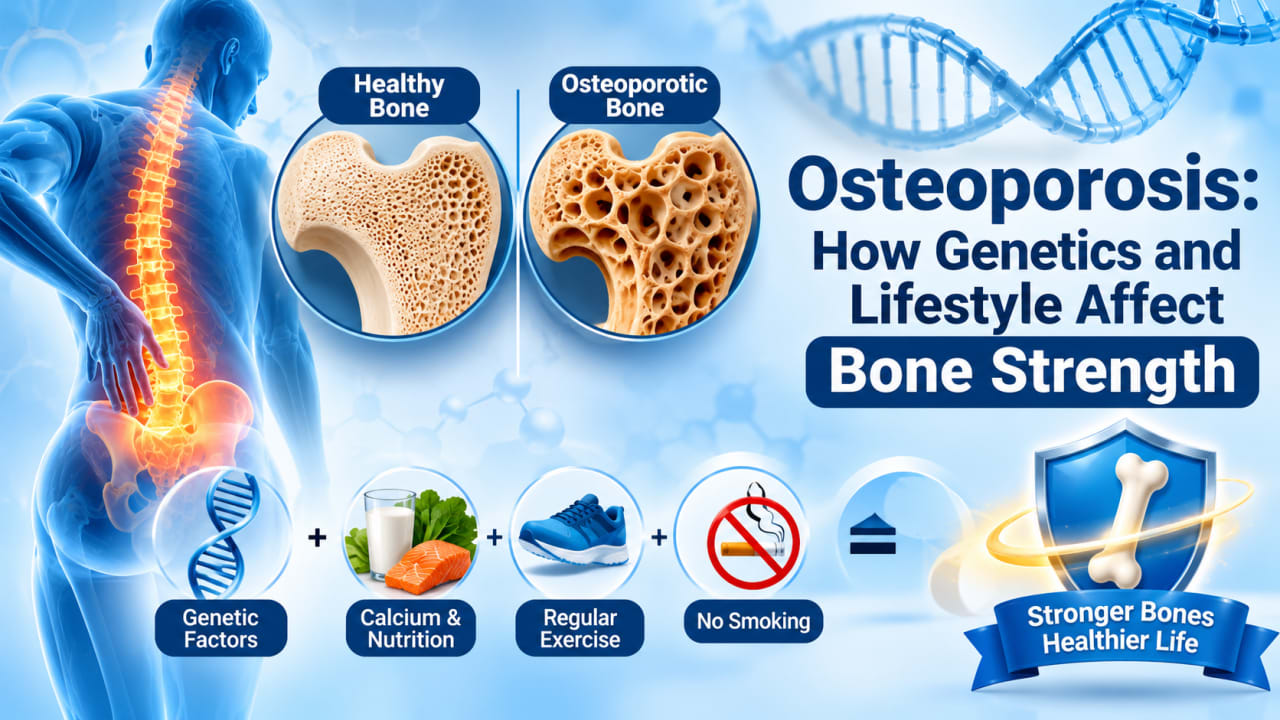
OSTEOPOROSIS : HOW GENETICS AND LIFESTYLE AFFECT BONE STRENGTH Osteoporosis is a systemic bone disease that weakens bones, making them fragile and much more likely to break. it is a silent disease that weakens bones over time, making them fragile and much more likely to break from a minor fall, bump or even a sneeze. WHY BONE HEALTH MATTERS • Preventing fractures: weak bones break easily, especially in the hip, spine and wrist. Hip and spine fractures can lead to severe pain, chronic disability , height loss ,stopped posture and a loss of independence. • Maintaining mobility: strong bones and muscles allow one to walk, bend and , move freely as one age. • Avoiding the ‘’silent’’ trap: osteoporosis shows no warning signs or symptoms until a bone actually breaks. WHAT ARE THE GENETIC CAUSES OF OSTEOPOROSIS ? Osteoporosis is a complex condition driven by a strong genetic component interacting with age , hormones and lifestyle. Polygenic (common) causes Most age –related osteoporosis is polygenic, meaning hundreds of small –effect genetic variants combine to influence peak bone mass, bone turnover, and fracture risk . Key genes involved are: 1. LRP5 and LRP6 : regulate the Wnt signaling pathway, which controls bone formation and strength. 2. COL 1A1: codes for type 1 collagen determining the structural integrity and cross-linking of the bone matrix. 3. ESR1/ ESR2 and CYP19: involve estrogen receptors and estrogen production ,which are vital for maintaining bone density in both men and women. 4. VDR: the vitamin D receptor gene, which influences how efficiently the body absorbs calcium. 5. RANK,RANKL and OPG/inflammatory cytokinesis : regulate the balance between bone-building osteoblasts and bone-reabsorbing osteoclasts. Monogenic (Rare) causes in rare instances, severe or early-onset osteoporosis is caused by mutation in a single gene or distinct genetic disorders: 1) Osteogenesis imperfecta : caused by mutations in collagen genes leading to severe skeletal fragility from childhood. 2) Idiopathic osteoporosis (IOP): unexplained severe osteoporosis in younger adults, sometimes linked to rare variants like RUNX1. 3) Other symptoms : conditions like hypophosphatasia (APL gene mutation) or LRP5-related high/low bone density disorders. HOW GENETICS INFLUENCE BONE MINERAL DENSITY (BMD)? Genetic account for roughly 50% to 85% of the variation in bone mineral density (BMD), making it a strongly heritable trait largely determined by polygenic factors. Key Genetic mechanisms 1) Genetic regulation of bone growth and development Genetic regulation of bone mineral density (BMD) is a highly polygenic and heritable trait, with genetic factors accounting for 50% to 85% of normal population variance. Normal bone density is controlled by many different genes working together rather than just a single gene. These genes influence bone building cells, bone reabsorbing cells, and how the body processes hormones like estrogen and vitamin D. 2) The role of genes in calcium absorption and bone metabolism Genetics heavily control how the body absorbs calcium and builds or maintain bone mass, accounting for a large portion of individual variance in bone mineral density and mineral metabolism. How genes influence calcium absorption 1) Intestinal uptake: dietary calcium requires functional active-transport machinery in the gut wall ,which is largely driven by vitamin D signaling via the vitamin D receptor . Genetic polymorphism can make this transport less efficient, meaning two people can eat the exact amount of calcium but absorbs different amounts at the cellular levels . 2) Renal handling: the kidneys reabsorb or excrete calcium based on signals from the CSAR gene and parathyroid hormone pathways, balancing blood calcium versus urine loss. Twin study shows that roughly 52% of the variance in calcium excretion is heritable. How the genes influence bone metabolism • Peak bone mass: up to 60% to 80% of variation in bone mineral density is determined by inherited genetic factors ,though modifiable lifestyle choices account for about 20% to40 % • Bone remodeling balance: genes control the signaling between osteoblasts and osteoclasts . twin and clinical data indicate that genetic influence accounts for up to 74% of variance in bone formation and 58% in bone reabsorption. WHAT ARE THE IMPORTANT GENES ASSOCIATED WITH OSTEOPOROSIS ? Osteoporosis is a polygenic and multifactorial condition, meaning it is influenced by the interaction of many genes combined with environmental and lifestyle factors . Genetics account for roughly 50% to 85% of the variation in bone mineral density (BMD) and fracture risk. Key genes associated with osteoporosis • COL1A1 (collagen Type1 alpha 1): encodes the primary organic component of the bone matrix. Variants affect collagen cross-linking and structural integrity, leading to weaker bone scaffolding even if mineral density appears normal. • LRP5 &LRP6(Low-density lipoprotein receptor –related protein 5/6): Act as cell-membrane coreceptors in the canonical Wnt signaling pathway, which regulates bone formation and bone mass accrual. • ESR1 &ESR2 (estrogen receptor Alpha &beta): code for estrogen receptor that play a major role in regulating bone turnover and preserving bone mass, particularly in postmenopausal women . polymorphism in ESR1 are strongly linked to hip and vertebral fracture susceptibility . • VDR(vitamin D Receptor): controls how the body absorbs dietary calcium and responds to vitamin D, influencing foundational mineral balance in bone tissue. • ING3&EPDR1: identified via genome-wide association studies as novel genes that significantly affect human osteoblasts and regional bone density • Other candidate &monogenic genes: Rare monogenic forms involve genes like CYP19 ,WNT1, PLS3 and structural genes liked to osteogenesis imperfecta overlap. IS OSTEOPOROSIS HEREDITARY ? Yes, osteoporosis has a strong hereditary and genetic component ,though it is not caused by a single gene. How Genetics play a role? • Bone mineral density (BMD): twin and family studies show that genetics account for roughly 60% to 80% of the variation in bone mineral density. • Polygenic condition: over 500 genetic variants and multiple loci influence bone structure, turnover and strength rather than a single ‘osteoporosis gene’ . • Family history: having a parent who suffered a fragility significantly increases the own risk of low bone density and fractures. • Peak bone mass: the genes help determine the maximum bone mass one build their youth and early 20s. Genetic V/S lifestyle While one cannot change their family history , genetics do not strictly dictate their future. Modifiable lifestyle factors account for about 20% to 40% of their peak bone mass and overall bone health. CONCLUSION Genetics and lifestyle work together to shape bone health ,determing both ones maximum potential strength and how fast they lose it over time. A family history of osteoporosis significantly increases the own risk of low bone density and fractures. Genetics load the gun ,but lifestyle pulls the trigger. One cannot altered their inherited genetic profile or family history. FREQUENTLY ASKED QUESTIONS (FAQs): QUESTION: IS OSTEOPOROSIS A GENETIC DISEASE? Yes, osteoporosis has a strong hereditary and genetic component ,though it is not caused by a single gene. QUESTION: CAN OSTEOPROSIS RUN IN FAMILES? Yes, osteoporosis can run in families. QUESTION: WHICH GENES ARE ASSOCIATED WITH OSTEOPROSIS? Osteoporosis is a complex ,polygenic condition influenced by many genes that regulate bone remodeling, mineral absorption, and structure. While common age-related osteoporosis involve hundreds of small –effect genetic variants ,specific major genes have been clearly linked to bone mineral density and fracture risk. QUESTION: CAN GENETIC TESTING PERDICT OSTEOPOROSIS ? Yes, genetic testing can help estimate the risk of developing osteoporosis or low bone mineral density ,though it cannot act as a standalone diagnostic tool. REFRENCES: 1https://my.clevelandclinic.org/health/diseases/4443-osteoporosis 2)https://medlineplus.gov/osteoporosis.html
OSTEOPOROSIS : HOW GENETICS AND LIFESTYLE AFFECT BONE STRENGTH
Onco Life India Editorial Team 7 min read
#Osteoporosis#Bone Health#Genetic Factors#Bone Density#Calcium#Vitamin D#Fracture Prevention#Lifestyle