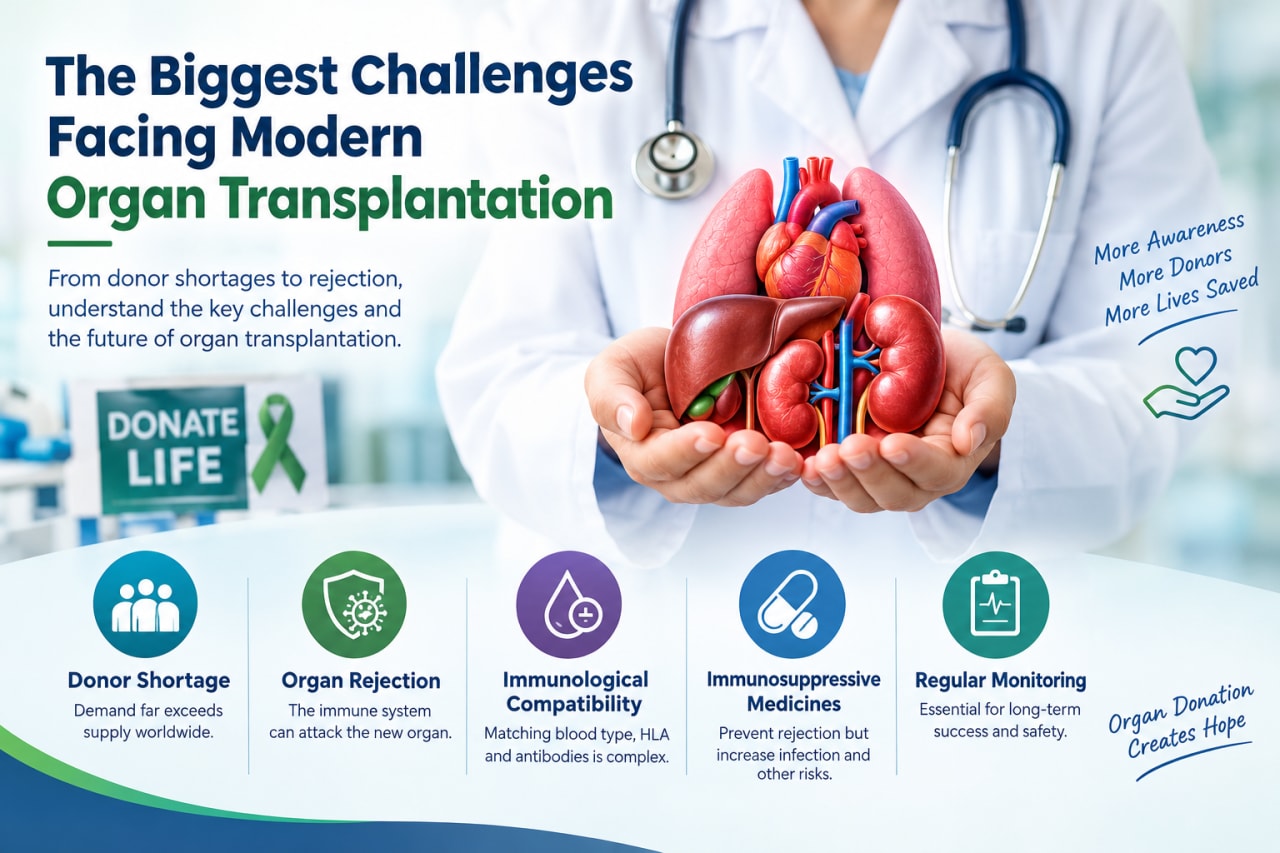
THE BIGGEST CHALLENGES FACING MODERN ORGAN TRANSPLANTATION Organ transplantation is a medical procedure where a falling or damaged organ is surgically removed and replaced with a healthy organ from a donor. It involves replacing non-functional cells ,organs, tissues or organs with healthy counterparts that are obtained from another individuals through voluntary donation during their lifetime or after the death. IMPORTANCE OF TRANSPLANTATION FOR PATEINTS WITH END-STAGE Organ transplantation is widely of care and the only definitive , curative treatment of patients experiencing end-stage organ failure . when a vital organ –such as heart , lungs, liver or kidneys –reaches a terminal and irreversible stage of decline, standard medical therapies and medications fall short of sustaining life. It is a critical pillar of mature , modern healthcare systems for several fundamental reasons. WHAT ARE THE MAJOR CHALLENGES IN TRANSPLANTATION? The major challenges in organ transplantation is the severe global shortage of available donor organs relative to the massive medical demand. Key challenges in Transplantation • Severe organ scarcity: demand drastically exceeds supply worldwide, forcing patient onto long waiting lists where many face high risk of deterioration or death. • Organ rejection and immunosuppression: the recipient’s immune system naturally attacks the foreign tissue. Lifelong immunosuppressant drugs prevent acute and chronic rejection , but they leave pateints highly vulnerable to severe infections, metabolic complications and secondary cancers. • Immunological compatibility : finding a precise match is complicated by blood type barriers, high panel-reactive antibodies, and human leukocyte antigen (HLA) mismatches. WHY IS THERE A SHORTAGE OF ORGAN DONOR? There is a severe shortage of organ donor because the number of people who need a transplant is much higher than the number of available organs from living and decreased donors. Main causes of the shortage • Lack of public Awareness : many people do not know how organ donation works or how to register as a donor. • Misconceptions and fear: myths about brain death, religious beliefs or cultural worries make families hesitant to agree. • Family refusal: even if a person wanted to donate , grieving family members often block the process at the last moment because they were not consulted beforehand or misunderstand the brain death. • Hospital infrastructure limit: many local hospitals lack the trained staff, equipment or specialized intensive care units required to identify potential donors and manage organ recovery. • Strict medical rules: organs can only be recovered if a person dies under specific medical conditions-such as brain death in a hospital ICU –making the pool of eligible decreased donors very small. WHAT IS TRANSPLANT REJECTION? Transplant rejection is a process where the recipient immune system attacks and tries to destroy a newly transplanted organ or tissue because it recognizes the donor cells as foreign. Types of organ rejection Organ rejection happens when a recipient’s immune system attacks a transplanted organ because it recognizes it as foreign tissue. There are 3 main types of organ rejection : • Hyperacute rejection It happens within minutes to hours after surgery. It occurs when the blood already has pre-formed antibodies against the donor. The organ must be removed immediately . • Acute rejection Happens anywhere from a week to few months after the transplant. It happens to some degree in most patients and is managed with adjustments to anti-rejection medications. • Chronic rejection Develops slowly over months or years . a steady ,long-term immune response causes scarring and gradual loss of organ function. WHY THE IMMUNE SYSTEM ATTACKS THE TRANSPLANTED ORGANS? The immune system attacks the transplanted organ because it recognizes the new tissue as a dangerous foreign intruder . Why rejection happens • Foreign markers: every person has unique surface proteins called human leukocyte antigens (HLA). These proteins act like a biological fingerprint . • The defender role: the immune system’s job is to hunt down and destroy anything that does not carry the body’s own natural ‘’self’’ markers. • Mistaken identity: when a donor organ is placed in a new body, the recipient immune cells see the donor’s different HLA fingerprints and mistake the lifesaving organ for a harmful virus or bacteria. WHAT IS THE ROLE OF IMMUNOSUPPRESSIVE MEDICINES? Immunosuppressive medicines lower the activity of the body’s immune system to prevent organ rejection and treat autoimmune conditions. Primary Roles: • organ and stem cell transplant: The body’s natural views a new organ or bone marrow as a foreign invader and attempts to reject it . Anti-rejection drugs quit this response so the body accepts the new tissue. • Autoimmune Diseases : in conditions like rheumatoid arthritis,https://oncomshealthcare.com/arthritis-_complete-guide-to-joint-pain-and-management/ lupus or chrons disease, the immune system mistakenly attacks healthy cells. These drugs hold back the immune response to reduce inflammation and tissue damage. Key risk • Infections: suppressing the immune system raises the risk of catching bacterial, viral and fungal infections . • Side effects: depending on the dosage and medication, risk can include kidney toxicity , high blood pressure and high blood sugar. WHAT IS THE ROLE OF REGULAR MONITORING IN IMMUNOSUPPRESIVE THERAPY? Regular monitoring in immunosuppressive therapy is vital to keep drug levels in a safe range that prevents organ rejection without causing severe toxicity . Why monitoring is necessary ? • Narrow therapeutic window: Drugs like tacrolimus and cyclosporine have a fine line between working safely and causing harm • Preventing rejection: if levels climb too high , it can cause serious organ damage such as kidney or dangerous infections . • High variability : every person absorbs and breaks down these medications differently based on diet , genetics and other drugs. CONCLUSION The conclusion regarding the biggest challenge facing modern transplantation centers on a dual reality : while surgical techniques and short-term survival rates have reached historic heights , the field remains severly constrained by critical organ scarcity and the long-term limitations of recipients immune system. FREQUENTLY ASKED QUESTIONS (FAQs): QUESTION: WHY IS THERE A SHORTAGE OF DONOR ORGANS? The number of patients requiring transplant is often greater than the number of suitable organs available . Donations rates, medical suitability and logical factors can all contribute to the shortage. QUESTION: WHAT IS ORGAN REJECTION? Organ rejection occurs when the recipients immune system recognises the transplanted organ as foreign and attacks it. Immunosuppressive medicines are used to reduce this risk. QUESTION: CAN ORGAN REJECTION BE PREVENTED COMPLTLEY? No, modern treatments can significantly reduce the risk ,but rejection can still occur. Regular follow-up and monitoring are important for detecting problems early. 1)Rhttps://my.clevelandclinic.org/health/treatments/11750-organ-donation-and-transplantationEFRENCES.: 2)https://www.narayanahealth.org/blog/organ-transplant-types-preparation-procedure-risks-and-complications
THE BIGGEST CHALLENGES FACING MODERN ORGAN TRANSPLANTATION Organ transplantation is a medical procedure where a falling or damaged organ is surgically removed and replaced with a healthy organ from a donor. It involves replacing non-functional cells ,organs, tissues or organs with healthy counterparts that are obtained from another individuals through voluntary donation during their lifetime or after the death. IMPORTANCE OF TRANSPLANTATION FOR PATEINTS WITH END-STAGE Organ transplantation is widely of care and the only definitive , curative treatment of patients experiencing end-stage organ failure . when a vital organ –such as heart , lungs, liver or kidneys –reaches a terminal and irreversible stage of decline, standard medical therapies and medications fall short of sustaining life. It is a critical pillar of mature , modern healthcare systems for several fundamental reasons. WHAT ARE THE MAJOR CHALLENGES IN TRANSPLANTATION? The major challenges in organ transplantation is the severe global shortage of available donor organs relative to the massive medical demand. Key challenges in Transplantation • Severe organ scarcity: demand drastically exceeds supply worldwide, forcing patient onto long waiting lists where many face high risk of deterioration or death. • Organ rejection and immunosuppression: the recipient’s immune system naturally attacks the foreign tissue. Lifelong immunosuppressant drugs prevent acute and chronic rejection , but they leave pateints highly vulnerable to severe infections, metabolic complications and secondary cancers. • Immunological compatibility : finding a precise match is complicated by blood type barriers, high panel-reactive antibodies, and human leukocyte antigen (HLA) mismatches. WHY IS THERE A SHORTAGE OF ORGAN DONOR? There is a severe shortage of organ donor because the number of people who need a transplant is much higher than the number of available organs from living and decreased donors. Main causes of the shortage • Lack of public Awareness : many people do not know how organ donation works or how to register as a donor. • Misconceptions and fear: myths about brain death, religious beliefs or cultural worries make families hesitant to agree. • Family refusal: even if a person wanted to donate , grieving family members often block the process at the last moment because they were not consulted beforehand or misunderstand the brain death. • Hospital infrastructure limit: many local hospitals lack the trained staff, equipment or specialized intensive care units required to identify potential donors and manage organ recovery. • Strict medical rules: organs can only be recovered if a person dies under specific medical conditions-such as brain death in a hospital ICU –making the pool of eligible decreased donors very small. WHAT IS TRANSPLANT REJECTION? Transplant rejection is a process where the recipient immune system attacks and tries to destroy a newly transplanted organ or tissue because it recognizes the donor cells as foreign. Types of organ rejection Organ rejection happens when a recipient’s immune system attacks a transplanted organ because it recognizes it as foreign tissue. There are 3 main types of organ rejection : • Hyperacute rejection It happens within minutes to hours after surgery. It occurs when the blood already has pre-formed antibodies against the donor. The organ must be removed immediately . • Acute rejection Happens anywhere from a week to few months after the transplant. It happens to some degree in most patients and is managed with adjustments to anti-rejection medications. • Chronic rejection Develops slowly over months or years . a steady ,long-term immune response causes scarring and gradual loss of organ function. WHY THE IMMUNE SYSTEM ATTACKS THE TRANSPLANTED ORGANS? The immune system attacks the transplanted organ because it recognizes the new tissue as a dangerous foreign intruder . Why rejection happens • Foreign markers: every person has unique surface proteins called human leukocyte antigens (HLA). These proteins act like a biological fingerprint . • The defender role: the immune system’s job is to hunt down and destroy anything that does not carry the body’s own natural ‘’self’’ markers. • Mistaken identity: when a donor organ is placed in a new body, the recipient immune cells see the donor’s different HLA fingerprints and mistake the lifesaving organ for a harmful virus or bacteria. WHAT IS THE ROLE OF IMMUNOSUPPRESSIVE MEDICINES? Immunosuppressive medicines lower the activity of the body’s immune system to prevent organ rejection and treat autoimmune conditions. Primary Roles: • organ and stem cell transplant: The body’s natural views a new organ or bone marrow as a foreign invader and attempts to reject it . Anti-rejection drugs quit this response so the body accepts the new tissue. • Autoimmune Diseases : in conditions like rheumatoid arthritis,https://oncomshealthcare.com/arthritis-_complete-guide-to-joint-pain-and-management/ lupus or chrons disease, the immune system mistakenly attacks healthy cells. These drugs hold back the immune response to reduce inflammation and tissue damage. Key risk • Infections: suppressing the immune system raises the risk of catching bacterial, viral and fungal infections . • Side effects: depending on the dosage and medication, risk can include kidney toxicity , high blood pressure and high blood sugar. WHAT IS THE ROLE OF REGULAR MONITORING IN IMMUNOSUPPRESIVE THERAPY? Regular monitoring in immunosuppressive therapy is vital to keep drug levels in a safe range that prevents organ rejection without causing severe toxicity . Why monitoring is necessary ? • Narrow therapeutic window: Drugs like tacrolimus and cyclosporine have a fine line between working safely and causing harm • Preventing rejection: if levels climb too high , it can cause serious organ damage such as kidney or dangerous infections . • High variability : every person absorbs and breaks down these medications differently based on diet , genetics and other drugs. CONCLUSION The conclusion regarding the biggest challenge facing modern transplantation centers on a dual reality : while surgical techniques and short-term survival rates have reached historic heights , the field remains severly constrained by critical organ scarcity and the long-term limitations of recipients immune system. FREQUENTLY ASKED QUESTIONS (FAQs): QUESTION: WHY IS THERE A SHORTAGE OF DONOR ORGANS? The number of patients requiring transplant is often greater than the number of suitable organs available . Donations rates, medical suitability and logical factors can all contribute to the shortage. QUESTION: WHAT IS ORGAN REJECTION? Organ rejection occurs when the recipients immune system recognises the transplanted organ as foreign and attacks it. Immunosuppressive medicines are used to reduce this risk. QUESTION: CAN ORGAN REJECTION BE PREVENTED COMPLTLEY? No, modern treatments can significantly reduce the risk ,but rejection can still occur. Regular follow-up and monitoring are important for detecting problems early. 1)Rhttps://my.clevelandclinic.org/health/treatments/11750-organ-donation-and-transplantationEFRENCES.: 2)https://www.narayanahealth.org/blog/organ-transplant-types-preparation-procedure-risks-and-complications
THE BIGGEST CHALLENGES FACING MODERN ORGAN TRANSPLANTATION Organ transplantation is a medical procedure where a falling or damaged organ is surgically removed and replaced with a healthy organ from a donor. It involves replacing non-functional cells ,organs, tissues or organs with healthy counterparts that are obtained from another individuals through voluntary donation during their lifetime or after the death. IMPORTANCE OF TRANSPLANTATION FOR PATEINTS WITH END-STAGE Organ transplantation is widely of care and the only definitive , curative treatment of patients experiencing end-stage organ failure . when a vital organ –such as heart , lungs, liver or kidneys –reaches a terminal and irreversible stage of decline, standard medical therapies and medications fall short of sustaining life. It is a critical pillar of mature , modern healthcare systems for several fundamental reasons. WHAT ARE THE MAJOR CHALLENGES IN TRANSPLANTATION? The major challenges in organ transplantation is the severe global shortage of available donor organs relative to the massive medical demand. Key challenges in Transplantation • Severe organ scarcity: demand drastically exceeds supply worldwide, forcing patient onto long waiting lists where many face high risk of deterioration or death. • Organ rejection and immunosuppression: the recipient’s immune system naturally attacks the foreign tissue. Lifelong immunosuppressant drugs prevent acute and chronic rejection , but they leave pateints highly vulnerable to severe infections, metabolic complications and secondary cancers. • Immunological compatibility : finding a precise match is complicated by blood type barriers, high panel-reactive antibodies, and human leukocyte antigen (HLA) mismatches. WHY IS THERE A SHORTAGE OF ORGAN DONOR? There is a severe shortage of organ donor because the number of people who need a transplant is much higher than the number of available organs from living and decreased donors. Main causes of the shortage • Lack of public Awareness : many people do not know how organ donation works or how to register as a donor. • Misconceptions and fear: myths about brain death, religious beliefs or cultural worries make families hesitant to agree. • Family refusal: even if a person wanted to donate , grieving family members often block the process at the last moment because they were not consulted beforehand or misunderstand the brain death. • Hospital infrastructure limit: many local hospitals lack the trained staff, equipment or specialized intensive care units required to identify potential donors and manage organ recovery. • Strict medical rules: organs can only be recovered if a person dies under specific medical conditions-such as brain death in a hospital ICU –making the pool of eligible decreased donors very small. WHAT IS TRANSPLANT REJECTION? Transplant rejection is a process where the recipient immune system attacks and tries to destroy a newly transplanted organ or tissue because it recognizes the donor cells as foreign. Types of organ rejection Organ rejection happens when a recipient’s immune system attacks a transplanted organ because it recognizes it as foreign tissue. There are 3 main types of organ rejection : • Hyperacute rejection It happens within minutes to hours after surgery. It occurs when the blood already has pre-formed antibodies against the donor. The organ must be removed immediately . • Acute rejection Happens anywhere from a week to few months after the transplant. It happens to some degree in most patients and is managed with adjustments to anti-rejection medications. • Chronic rejection Develops slowly over months or years . a steady ,long-term immune response causes scarring and gradual loss of organ function. WHY THE IMMUNE SYSTEM ATTACKS THE TRANSPLANTED ORGANS? The immune system attacks the transplanted organ because it recognizes the new tissue as a dangerous foreign intruder . Why rejection happens • Foreign markers: every person has unique surface proteins called human leukocyte antigens (HLA). These proteins act like a biological fingerprint . • The defender role: the immune system’s job is to hunt down and destroy anything that does not carry the body’s own natural ‘’self’’ markers. • Mistaken identity: when a donor organ is placed in a new body, the recipient immune cells see the donor’s different HLA fingerprints and mistake the lifesaving organ for a harmful virus or bacteria. WHAT IS THE ROLE OF IMMUNOSUPPRESSIVE MEDICINES? Immunosuppressive medicines lower the activity of the body’s immune system to prevent organ rejection and treat autoimmune conditions. Primary Roles: • organ and stem cell transplant: The body’s natural views a new organ or bone marrow as a foreign invader and attempts to reject it . Anti-rejection drugs quit this response so the body accepts the new tissue. • Autoimmune Diseases : in conditions like rheumatoid arthritis,https://oncomshealthcare.com/arthritis-_complete-guide-to-joint-pain-and-management/ lupus or chrons disease, the immune system mistakenly attacks healthy cells. These drugs hold back the immune response to reduce inflammation and tissue damage. Key risk • Infections: suppressing the immune system raises the risk of catching bacterial, viral and fungal infections . • Side effects: depending on the dosage and medication, risk can include kidney toxicity , high blood pressure and high blood sugar. WHAT IS THE ROLE OF REGULAR MONITORING IN IMMUNOSUPPRESIVE THERAPY? Regular monitoring in immunosuppressive therapy is vital to keep drug levels in a safe range that prevents organ rejection without causing severe toxicity . Why monitoring is necessary ? • Narrow therapeutic window: Drugs like tacrolimus and cyclosporine have a fine line between working safely and causing harm • Preventing rejection: if levels climb too high , it can cause serious organ damage such as kidney or dangerous infections . • High variability : every person absorbs and breaks down these medications differently based on diet , genetics and other drugs. CONCLUSION The conclusion regarding the biggest challenge facing modern transplantation centers on a dual reality : while surgical techniques and short-term survival rates have reached historic heights , the field remains severly constrained by critical organ scarcity and the long-term limitations of recipients immune system. FREQUENTLY ASKED QUESTIONS (FAQs): QUESTION: WHY IS THERE A SHORTAGE OF DONOR ORGANS? The number of patients requiring transplant is often greater than the number of suitable organs available . Donations rates, medical suitability and logical factors can all contribute to the shortage. QUESTION: WHAT IS ORGAN REJECTION? Organ rejection occurs when the recipients immune system recognises the transplanted organ as foreign and attacks it. Immunosuppressive medicines are used to reduce this risk. QUESTION: CAN ORGAN REJECTION BE PREVENTED COMPLTLEY? No, modern treatments can significantly reduce the risk ,but rejection can still occur. Regular follow-up and monitoring are important for detecting problems early. 1)Rhttps://my.clevelandclinic.org/health/treatments/11750-organ-donation-and-transplantationEFRENCES.: 2)https://www.narayanahealth.org/blog/organ-transplant-types-preparation-procedure-risks-and-complications
THE BIGGEST CHALLENGES FACING MODERN ORGAN TRANSPLANTATION Organ transplantation is a medical procedure where a falling or damaged organ is surgically removed and replaced with a healthy organ from a donor. It involves replacing non-functional cells ,organs, tissues or organs with healthy counterparts that are obtained from another individuals through voluntary donation during their lifetime or after the death. IMPORTANCE OF TRANSPLANTATION FOR PATEINTS WITH END-STAGE Organ transplantation is widely of care and the only definitive , curative treatment of patients experiencing end-stage organ failure . when a vital organ –such as heart , lungs, liver or kidneys –reaches a terminal and irreversible stage of decline, standard medical therapies and medications fall short of sustaining life. It is a critical pillar of mature , modern healthcare systems for several fundamental reasons. WHAT ARE THE MAJOR CHALLENGES IN TRANSPLANTATION? The major challenges in organ transplantation is the severe global shortage of available donor organs relative to the massive medical demand. Key challenges in Transplantation • Severe organ scarcity: demand drastically exceeds supply worldwide, forcing patient onto long waiting lists where many face high risk of deterioration or death. • Organ rejection and immunosuppression: the recipient’s immune system naturally attacks the foreign tissue. Lifelong immunosuppressant drugs prevent acute and chronic rejection , but they leave pateints highly vulnerable to severe infections, metabolic complications and secondary cancers. • Immunological compatibility : finding a precise match is complicated by blood type barriers, high panel-reactive antibodies, and human leukocyte antigen (HLA) mismatches. WHY IS THERE A SHORTAGE OF ORGAN DONOR? There is a severe shortage of organ donor because the number of people who need a transplant is much higher than the number of available organs from living and decreased donors. Main causes of the shortage • Lack of public Awareness : many people do not know how organ donation works or how to register as a donor. • Misconceptions and fear: myths about brain death, religious beliefs or cultural worries make families hesitant to agree. • Family refusal: even if a person wanted to donate , grieving family members often block the process at the last moment because they were not consulted beforehand or misunderstand the brain death. • Hospital infrastructure limit: many local hospitals lack the trained staff, equipment or specialized intensive care units required to identify potential donors and manage organ recovery. • Strict medical rules: organs can only be recovered if a person dies under specific medical conditions-such as brain death in a hospital ICU –making the pool of eligible decreased donors very small. WHAT IS TRANSPLANT REJECTION? Transplant rejection is a process where the recipient immune system attacks and tries to destroy a newly transplanted organ or tissue because it recognizes the donor cells as foreign. Types of organ rejection Organ rejection happens when a recipient’s immune system attacks a transplanted organ because it recognizes it as foreign tissue. There are 3 main types of organ rejection : • Hyperacute rejection It happens within minutes to hours after surgery. It occurs when the blood already has pre-formed antibodies against the donor. The organ must be removed immediately . • Acute rejection Happens anywhere from a week to few months after the transplant. It happens to some degree in most patients and is managed with adjustments to anti-rejection medications. • Chronic rejection Develops slowly over months or years . a steady ,long-term immune response causes scarring and gradual loss of organ function. WHY THE IMMUNE SYSTEM ATTACKS THE TRANSPLANTED ORGANS? The immune system attacks the transplanted organ because it recognizes the new tissue as a dangerous foreign intruder . Why rejection happens • Foreign markers: every person has unique surface proteins called human leukocyte antigens (HLA). These proteins act like a biological fingerprint . • The defender role: the immune system’s job is to hunt down and destroy anything that does not carry the body’s own natural ‘’self’’ markers. • Mistaken identity: when a donor organ is placed in a new body, the recipient immune cells see the donor’s different HLA fingerprints and mistake the lifesaving organ for a harmful virus or bacteria. WHAT IS THE ROLE OF IMMUNOSUPPRESSIVE MEDICINES? Immunosuppressive medicines lower the activity of the body’s immune system to prevent organ rejection and treat autoimmune conditions. Primary Roles: • organ and stem cell transplant: The body’s natural views a new organ or bone marrow as a foreign invader and attempts to reject it . Anti-rejection drugs quit this response so the body accepts the new tissue. • Autoimmune Diseases : in conditions like rheumatoid arthritis,https://oncomshealthcare.com/arthritis-_complete-guide-to-joint-pain-and-management/ lupus or chrons disease, the immune system mistakenly attacks healthy cells. These drugs hold back the immune response to reduce inflammation and tissue damage. Key risk • Infections: suppressing the immune system raises the risk of catching bacterial, viral and fungal infections . • Side effects: depending on the dosage and medication, risk can include kidney toxicity , high blood pressure and high blood sugar. WHAT IS THE ROLE OF REGULAR MONITORING IN IMMUNOSUPPRESIVE THERAPY? Regular monitoring in immunosuppressive therapy is vital to keep drug levels in a safe range that prevents organ rejection without causing severe toxicity . Why monitoring is necessary ? • Narrow therapeutic window: Drugs like tacrolimus and cyclosporine have a fine line between working safely and causing harm • Preventing rejection: if levels climb too high , it can cause serious organ damage such as kidney or dangerous infections . • High variability : every person absorbs and breaks down these medications differently based on diet , genetics and other drugs. CONCLUSION The conclusion regarding the biggest challenge facing modern transplantation centers on a dual reality : while surgical techniques and short-term survival rates have reached historic heights , the field remains severly constrained by critical organ scarcity and the long-term limitations of recipients immune system. FREQUENTLY ASKED QUESTIONS (FAQs): QUESTION: WHY IS THERE A SHORTAGE OF DONOR ORGANS? The number of patients requiring transplant is often greater than the number of suitable organs available . Donations rates, medical suitability and logical factors can all contribute to the shortage. QUESTION: WHAT IS ORGAN REJECTION? Organ rejection occurs when the recipients immune system recognises the transplanted organ as foreign and attacks it. Immunosuppressive medicines are used to reduce this risk. QUESTION: CAN ORGAN REJECTION BE PREVENTED COMPLTLEY? No, modern treatments can significantly reduce the risk ,but rejection can still occur. Regular follow-up and monitoring are important for detecting problems early. 1)Rhttps://my.clevelandclinic.org/health/treatments/11750-organ-donation-and-transplantationEFRENCES.: 2)https://www.narayanahealth.org/blog/organ-transplant-types-preparation-procedure-risks-and-complications
Medical disclaimer: This article is for general educational purposes only. It does not replace professional medical advice, diagnosis, or treatment. Patients should consult their transplant team for individualized care.