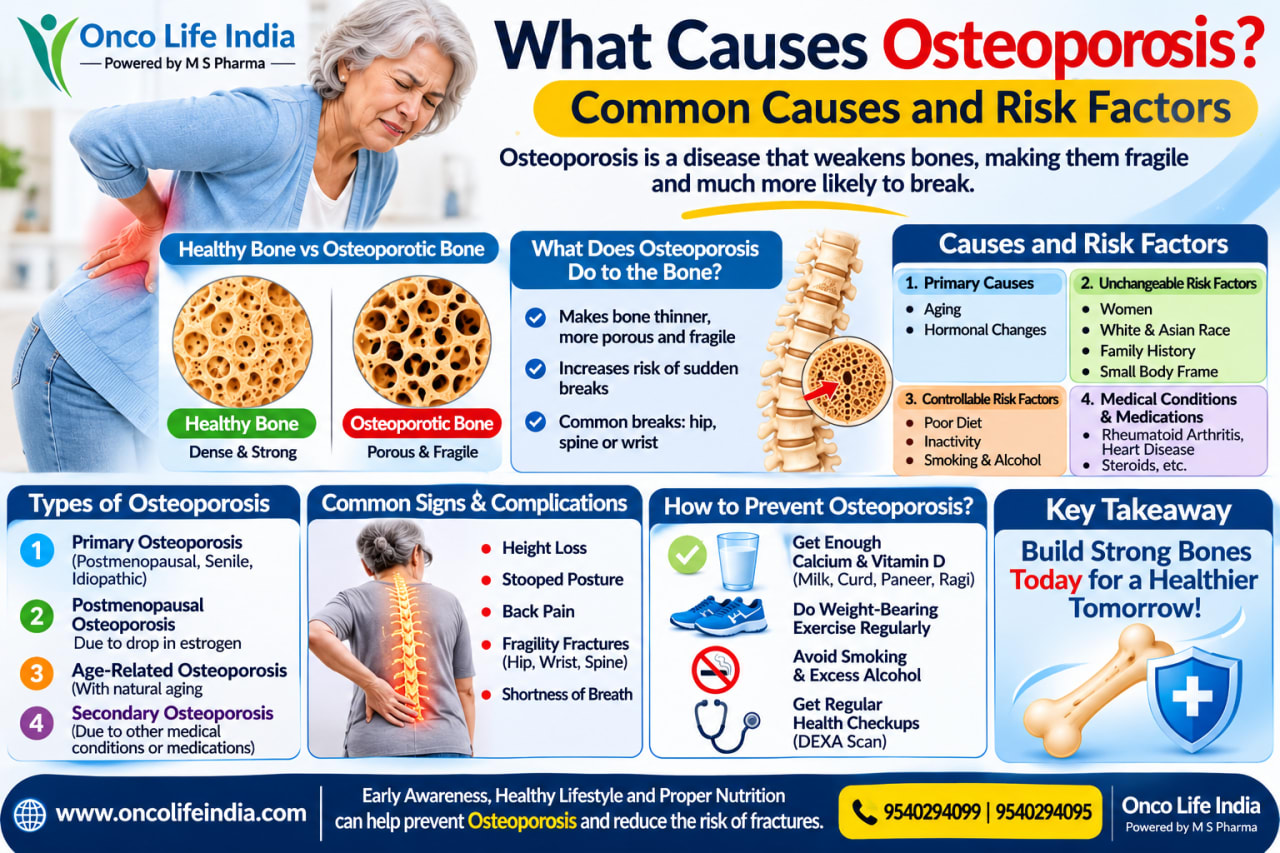
WHAT CAUSES OSTEOPOROSIS ? COMMON CAUSES AND RISK FACTORS
Osteoporosis is a medical disease that weakens bones , making them fragile and much more likely to break because the body losses bone mass faster than it can create new bone. It is a serious medical condition because it silently weakens bones , making them fragile and much more likely to break. Breaks can happen from minor fall to everyday movement commonly in the hips, spine or wrist. WHAT DOES OSTEOPOROSIS DO TO THE BONE? Osteoporosis makes bone thinner, more porous, and extremely fragile, greatly increasing the risk of sudden breaks.
• How it changes bone structure
- Honeycomb breakdown: Healthy bones look like a tight ,solid honeycomb under a microscope. Osteoporosis enlarge the holes and spaces inside this matrix, destroying the internal scaffolding.
2. Loss of mass: Bone is living tissue that constantly rebuilds itself. With Osteoporosis , the body breaks down old bone faster than it can create new bone.
3. Outer shell thinning: The thick outer layer of the bone also becomes week and thin.
• Common effects and complications
- Fragility fractures: Bones can break from minor bumps, everyday movements like bending over or simple fall.
2. Spine compression: Vertebrate in the break can weaken and collapse ,leading to severe back pain, a hunched posture and a loss of height .
3. Common sites: Hips, wrist and spinal bones are the most frequently affected areas. WHAT ARE THE CAUSES AND RISK FACTOR OF OSTEOPOROSIS?
Osteoporosis is cause when the body breaks down old bone faster than it can create new bone, leading to weak and porous bone.
1) Primary causes
• Aging: Bone mass peak around age 30, and after 35, the body naturally breaks down bone faster than it builds it.
• Hormonal changes: Dropping estrogen levels during menopause in women or reduced testosterone in men speed up bone loss.
• 2)Unchangeable risk factors
• Sex: women develop osteoporosis much more often than man.
• Race: white and Asian individuals face the highest risk.
• Family history: having a parent or sibling with the condition increases one personal risk
• Body frame: people with small, thin body frames have less bone mass to draw from as they age.
• 3)Controllable risk factors
• Poor Diet: a lifelong lack of calcium and vitamin D weakens the bone structure.
• Inactivity: A sedentary lifestyle without enough weight –bearing exercise lead to weaker bones
• Substance use: smoking tobacco and drinking more than two alcoholic drinks daily increase the bone loss rate.
• 4)Medical conditions and medications
• Health issues: conditions like rheumatoid arthritis , cardiac diseases, and endocrine disorders contribute to bone weakning.
• Medications: long-term use of certain drugs, such as oral corticosteroids , proton pump inhibitors, and seizure medications can impair bone density. WHAT ARE THE TYPES OF OSTEOPOROSIS ? Types of osteoporosis are:
- Primary osteoporosis
Primary osteoporosis is a bone weakening condition that happens naturally from aging and changing hormone levels rather than from an outside disease or medication.
Types of primary osteoporosis
A)Type 1 (postmenopausal)
Happens to women after menopause because of a sudden drop in estrogen . it mostly affect spongy inner bone and often causes wrist or spine fractures
B)Type 2 (senile)
Happens to older adults ,usually over 75 . it effects both spongy and hard outer bone due to long term aging and lower calcium absorption.
C)Idiopathic
A rare type that affects children ,teens or younger adults for unknown reasons. Common signs and risk
• Asymptomatic : causes no pain or early signs until sudden bone break or fracture happens
• Physical changes: can lead to curved upper back and lower back pain.
• Risk factors: getting older , being female ,family history and low intake of calcium and vitamin D.
Diagnosis and management
• Testing :Doctors use a painless x-ray test called DEXA scan to measure bone mineral density
• Treatment: includes weight-bearing exercises, vitamin and mineral supplements and prescription medications that slows down bone loss.
• Postmenopausal osteoporosis
Postmenopausal osteoporosis is a condition where bones become weak and break easily because lower estrogen levels cause rapid bone loss.
Causes and risks
• Estrogen drop: Estrogen protects bones, so its loss after menopause speeds up bone breakdown.
• Nutrients: low calcium and vitamin D makes bones weaker
• Habits: smoking and drinking too much alcohol increases bone loss
Diagnosis
• DEXA scan: A special Bone Density Scan measure bone strength and gives a T_score
• Fracture Check: Doctors look for past broken bones from minor falls.
Treatment and prevention
• Lifestyle: eat foods rich in calcium and get enough vitamin D.
• Exercise : Do weight-bearing activites and strength training
• Medicines: Doctors may pescribe hormone therapy, bisphosphonates or other bone building drugs. A)Age –related osteoporosis
Age-related osteoporosis is a medical condition where bones become week ,thin, fragile over time because bone breakdown happens faster than the new bone creation. Causes and risk factors:
• Natural Aging : Peak bones mass happens around age 30 . after 35, the body breaks down bone faster than it build new bone
• Hormone changes: the drop in estrogen during menopause speeds up bone loss in women. Lower testosterone can also effect men.
• Genetics and body size: people with a family history of fractures or a small , thin, body frame face a higher risk.
• Diet and lifestyle: not getting enough calcium, vitamin D, or protein along with smoking and lack of exercise, weakens bone faster. Common signs
• Height loss of an inch or more
• Stooping or hunched posture
• Lower back pain caused by weak or collapsed spinal cord
• Shortness of breath if compressed spine bones reduced the lung capacity.
• B)Secondary osteoporosis
Secondary osteoporosis is a bone loss caused by underlying medical conditions , a medication or a lifestyle habit rather than just aging. Common Causes
• Medications: long-term use of steroids anti-seizure drugs, and certain cancer treatments
• Health conditions: Hormone problem , gastrointestinal diseases and chronic kidney disease or liver diseases.
Symptoms and diagnosis
• No early signs: it rarely causes symptoms until a bone breaks
• Testing: doctors use blood test and bone density scans to find weak bones and look for hidden causes . Treatment
• Treat the root cause: Doctors focus on managing the specific disease or changing problematic medications
• Bone support: treatments may also include calcium, vitamin D and bone strengthening drugs.
HOW TO PREVENT OSTEOPOROSIS?
Osteoporosis prevention in India involves a multifaceted approach that includes dietary changes, regular health checkups and adherence to medical treatment plans. Some of the key strategies for preventing osteoporosis are:
1) Dietary intake: incorporate foods rich in calcium and vitamin D into your diet. Foods like curd,milk,panner and ragi are excellent sources of these nutrients
2) Regular health checkups: schedule DEXA scans to measure bone mineral density and monitor bone health
3) Medications: follow prescribed medications for calcium and vitamin D supplements and consultant healthcare providers for any additional treatment
4) Lifestyle changes: Engage in regular physical activity, maintain a healthy weight and avoid smoking and excessive alcohol consumption CONCLUSION
Osteoporosis is a major health threat defined by week bones and a high risk of fractures . Building strong bones during youth help lower later risk. Good food, vitamin D and exercise protect bone strength . scans like DEXA help find bone loss early. Doctors use special drugs and lifestyle plans to stop break . FREQUENTLY ASKED QUESTIONS
QUESTION: WHAT IS THE MAIN CAUSE OF OSTEOPOROSIS ?
The main cause of osteoporosis is an imbalance between bone breakdown and bone formation, where the body losses bone mass faster than it can create new bone. This is primarily driven by aging and hormonal changes-especially the sharp drop in estrogen during menopause in women or testosterone in men.
QUESTION: CAN OSTEOPOROSIS BE CAUSED BY A LACK OF CALCIUM?
Yes, a lifelong lack of calcium plays a major role in the development of osteoporosis . when the body does not get enough calcium from the diet, it takes calcium out of the bones to keep blood levels normal. Over time, the constant removal lowers the bone mass and makes the bone weak, thin and prone to breaking. QUESTION: DOES MENOPAUSE INCREASE THE RISK OF OSTEOPOROSIS ?
Menopause increase the risk of osteoporosis because declining estrogen levels speedup the natural breakdown of bone faster than the he body can rebuild it. Women can lose upto 10% of their bone density in the first five years after menopause. Women who reach menopause before age of 45 face an even higher risk because they lose the protective effects of estrogen at a younger age.
REFRENCES:
1)https://www.ncbi.nlm.nih.gov/books/NBK559156/